

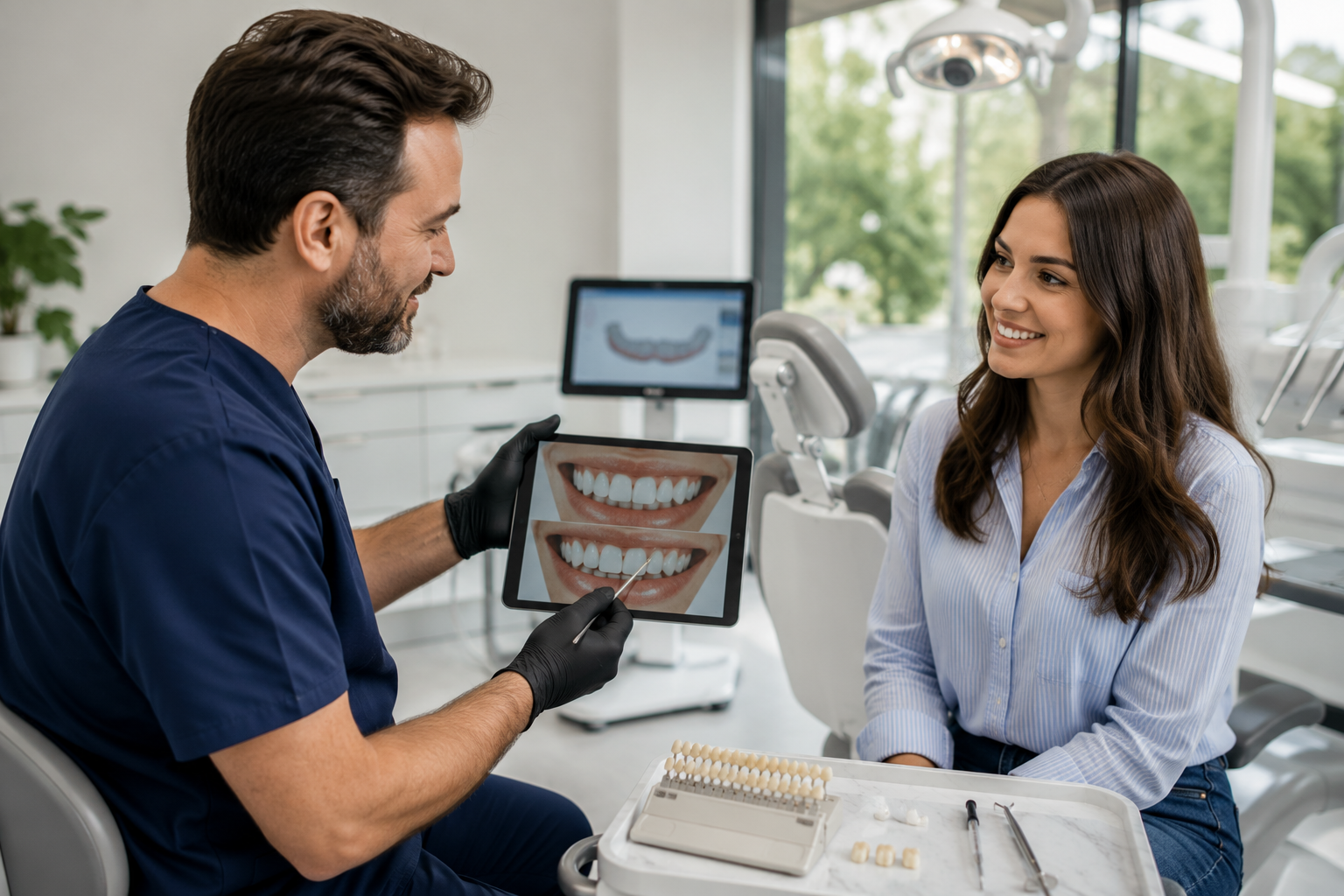
Both dental bonding and veneers can fix chips, gaps, staining, and uneven teeth. They use different materials, require different levels of commitment, and suit different budgets and goals. The right choice depends on which specific problem you want to solve and how long you want the result to last.
At Newfield Dental in Stamford, CT, our team offers both treatments and helps patients across Fairfield County decide which fits their situation. The answer is rarely one-size-fits-all, but there are clear patterns that make one option the better choice for most cases.
Bonding vs. veneers: side-by-side comparison
| Factor | Dental bonding | Porcelain veneers |
| Material | Composite resin (applied by hand) | Custom porcelain shell (lab-made) |
| Visits | 1 visit (same day) | 2-3 visits over 2-4 weeks |
| Enamel removal | None or minimal (reversible) | Thin layer removed (permanent) |
| Lifespan | 5-7 years (some up to 10) | 10-15+ years |
| Stain resistance | Moderate (can discolor over time) | High (porcelain is non-porous) |
| Cost (Stamford CT) | $250-$600 per tooth | $900-$2,000 per tooth |
| Anesthesia needed? | Rarely | Usually yes for preparation |
| Best for | 1-2 minor chips, gaps, or touch-ups | Multiple teeth, lasting transformation |
Dental bonding vs. veneers comparison for patients in Stamford, CT and Fairfield County. Costs are 2026 estimates. Contact Newfield Dental for a personalized assessment.
What is dental bonding?
Dental bonding uses a tooth-colored composite resin, the same material used in white fillings, applied directly to the surface of the tooth. The dentist shapes it by hand, hardens it with a curing light, and polishes it to blend with surrounding teeth. The process takes 30 to 60 minutes per tooth and is usually done without anesthesia.
Because bonding adds material without removing any natural tooth structure, it is considered reversible. If you change your mind, the bonding can be removed and replaced, or upgraded to veneers without any additional tooth preparation.
The American Dental Association classifies composite resin as one of the most widely used materials in modern dentistry, valued for its ability to bond directly to enamel with minimal removal of natural tooth structure.
What bonding works well for
- A single chipped or cracked front tooth
- Closing a small gap between two teeth
- Covering minor staining that does not respond to whitening
- Reshaping a tooth that is slightly shorter or irregular
- Patients who want a quick, affordable improvement without committing to a permanent change
Bonding limitations to know
Composite resin is more porous than porcelain. Coffee, tea, red wine, and tobacco can stain it over time, and staining cannot be reversed with whitening once the bonding is in place. This is why dentists recommend whitening your natural teeth to your target shade at least two weeks before bonding, so the resin can be matched to a lighter color from the start.
Bonding is also softer than porcelain and more vulnerable to chipping under force. Patients who grind their teeth at night should discuss a custom nightguard with their dentist before choosing bonding for front teeth.
You can explore the bonding treatment at Newfield Dental on our dental bonding page.
What are porcelain veneers?
Porcelain veneers are thin shells of custom-fabricated ceramic bonded to the front surface of the tooth. Each veneer is designed in a dental laboratory from impressions or digital scans taken at the dental office. The process takes two to three appointments over two to four weeks.
Unlike bonding, placing veneers requires removing a thin layer of enamel, typically 0.3 to 0.5 mm, to create space for the shell. This makes the process permanent: once enamel is removed, the tooth will always need a veneer or crown. Patients who are not ready for that commitment should start with bonding.
Porcelain is non-porous, which means veneers resist staining from food and drink far better than bonding. The ceramic also mimics the light-reflecting properties of natural enamel, producing results that look virtually identical to real teeth when done well.
What veneers work well for
- Multiple front teeth with discoloration, chips, or shape inconsistencies
- Teeth that have not responded adequately to whitening
- Patients who want a lasting result and are ready for a permanent commitment
- Cases where shape, length, and color all need to be changed at once
- Smile redesigns covering six to eight upper front teeth
Veneer limitations to know
Veneers require a larger upfront investment and two to three dental visits. They are not the right starting point for patients with active gum disease, significant tooth decay, or bite issues that have not been addressed. Those conditions must be resolved first.
Minimally-invasive no-prep options, which require little to no enamel removal, are available for patients with mild corrections who want to preserve tooth structure. Your dentist will advise whether your teeth are candidates.
Learn more about how veneers are placed at our porcelain veneers page.
Ready to talk through your options with a cosmetic dentist in Stamford? Contact Newfield Dental to schedule a no-pressure consultation.
Which is right for you? A practical decision guide
| Your situation | Likely best fit |
| One chipped or cracked front tooth | Bonding |
| Small gap between two front teeth | Bonding |
| Minor staining on one or two teeth | Bonding (whiten first, then match) |
| Multiple teeth with color, shape, or chip issues | Veneers |
| Teeth that have not whitened adequately | Veneers |
| Budget is the primary constraint right now | Bonding (can upgrade to veneers later) |
| Want results that last 10-15+ years without touch-ups | Veneers |
| Prefer reversible treatment before committing | Bonding first |
| Grinding teeth at night (bruxism) | Either, with a custom nightguard |
Decision guide for dental bonding vs. veneers. Newfield Dental provides personalized recommendations during a consultation based on your specific teeth and goals.
One path that works well for many Stamford patients: start with bonding to correct the most noticeable issue, see how you feel about cosmetic dentistry, then upgrade to veneers when you are ready. Since bonding does not remove enamel, a bonded tooth can be prepared for a veneer at any time without additional tooth reduction.
How long does dental bonding last vs. veneers?
Dental bonding typically lasts five to seven years before needing touch-ups or replacement. With excellent care, some bonding holds up to ten years on teeth with lower bite pressure. Chipping is the most common reason for earlier replacement, usually from nail biting, pen chewing, or biting hard food directly with front teeth.
Porcelain veneers last ten to fifteen years or longer with proper care. Cases where patients maintain good oral hygiene, avoid grinding without a nightguard, and attend regular dental cleanings commonly reach the fifteen-year mark. The ceramic itself does not stain or degrade; wear typically shows at the bonding margin over time.
Is dental bonding covered by insurance?
Whether insurance covers bonding depends on why it is being done. If bonding repairs a tooth that is chipped, cracked, or structurally damaged, most insurers cover it partially under restorative benefits, typically 50 to 80% after the deductible, using the CDT code D2330 or similar.
Purely cosmetic bonding, such as closing a gap on a healthy tooth, is classified as elective and is not covered. Porcelain veneers are almost always excluded from insurance coverage as cosmetic procedures.
The Newfield Dental care team can review your specific policy and confirm coverage before treatment begins. Both treatments can be paid using HSA or FSA funds, which effectively reduces cost by your marginal tax rate. Flexible payment plans are also available for patients financing larger cosmetic cases.
Frequently asked questions
How long does dental bonding last?
Bonding typically lasts five to seven years with normal care. Lifespan depends on the location of the bonded tooth, bite forces, and habits such as nail biting or chewing ice. Teeth with lower bite pressure and patients who avoid staining foods and drinks tend to get longer results. Touch-ups can extend the life of bonding without starting over from scratch.
Does dental bonding hurt?
Bonding is one of the most comfortable cosmetic procedures in dentistry. It typically requires no anesthesia because no drilling near the nerve is involved. The tooth surface is lightly etched to help the resin adhere, and the curing light used to harden the material produces no discomfort. Patients with existing sensitivity may feel mild cold sensitivity during the process.
Can dental bonding be whitened?
No. Once composite resin is placed, it cannot be whitened with bleaching agents. Natural tooth enamel responds to whitening; composite does not. For this reason, it is strongly recommended to complete any teeth whitening at least two weeks before bonding treatment. This allows your dentist to match the resin to your newly whitened shade. If you are considering whitening and bonding, visit our teeth whitening page to learn about our options.
Is dental bonding covered by insurance?
Bonding used to repair a chipped or cracked tooth is often partially covered under restorative benefits, typically 50-80% after your deductible. Cosmetic bonding on an otherwise healthy tooth is usually excluded. Veneers are almost never covered. Always confirm your benefits with your insurer before scheduling, and ask your dentist which CDT code applies to your specific procedure.
Both dental bonding and porcelain veneers are available at Newfield Dental in Stamford. Schedule a consultation and our team will walk through your specific teeth, your goals, and give you an honest recommendation for which treatment makes the most sense, without pressure to choose the more expensive option.